Showing posts with label alto saxophone. Show all posts

Saturday, April 20, 2013

Featuring: Opus USA

Some Original Information

     I've got some interesting information for all you saxophone fans out there about a little known brand called Opus USA: the brand is actually an off-brand of the Yanagisawa saxophones!
     Opus sells saxophones very inexpensively, though a pretty good quality. In fact, the saxophones have a great response in the key work, and are generally of sound intonation. They provide options for several finishes and colors, which is also rather nice. The brand is really something, especially for anyone looking for a cheap saxophone to buy (I got a curved soprano from Opus for $240 and a black/gold alto for about the same).
     This is all well and good, but none of it is particularly surprising  It was when I was jamming with a friend, however, that I saw something interesting: my Opus USA alto and soprano saxophones looked identical to my friend's pro Yanagisawa alto. The key work, the pearls and the guard designs were all the same on either saxophone. This information was interesting to me, as it would seem that an American company has started off branding an Asian company, quite the opposite to popular debate. This scenario would seem to put a wrench in many bloggers' ideas on off-brand saxophones, that Asian off-brands are the rout of all evil. 
     No, instead this information led me to believe that off-brand saxophones are without borders and, in fact, are necessary for creating a diverse saxophone market. Here's a big bit of my point: big brands like Selmer and Yamaha should stick to advanced and pro level horns, leaving student pieces to brands such as Opus. Why? Simple. For the same price as a YAS-23 (Yamaha student alto sax), you can get a "pro", good looking, fully functional alto sax from Opus that, quite frankly, plays better than the Yamaha.
     This might be shocking to a lot of people, but it's my opinion on the matter, and I strongly maintain that it's a good idea. There's no disputing the big-name brands' skills at designing and building the greatest pro horns, but when it comes to student saxophones, you have to think inexpensive- the most band for your buck. Can a low-budget music program at a high school afford ten saxophones from Store X? 
     Opus USA makes saxophones that don't look student (they aren't brass colored horns with silver key work). They make good looking saxophones at a low price. They modeled the saxophones after Yanagisawas, which is smart- Yanagisawa is no slouch. 
Black and Gold Opus Alto

Monday, September 3, 2012

In Tune with the Old Ways

Vintage Saxophones

     I'm sure at one point or another anyone who has heard of a saxophone has heard about vintage saxophones, at least a little bit. These are simply old saxophones- those that have made it through the test of time. For vintage saxophones, there are a few large periods of time that are most notable: the late 1800's, the 1920's, 1930-40's and 1950-60's. If you do your research, you'll see a clear path through time, where changes were made constantly between the 1800's and today.
     In today's modern age we have some pretty responsive saxophones due to advanced metals used in springs, and clear sounding tone thanks to the brass work done in the body. Today's top saxophones are made with blue steel springs enabling faster key work, as well as a ridged two-part brass body for durability and decreased air resistance. Yamaha and Selmer brands in particular are the front runners for today's modern sax.
     However, the old saxophones that are still able to be played have a rather unique sound to them. They're often described as darker, or warmer sounding. This sound is popular among jazz artists- some of whom actually have vintage horns which they got themselves when the horn premiered. They also have that vintage 'look' to them: they're worn and beat up simply from being 'alive' for so long. You might feel all of the experience that the saxophone has as you play it.
     The combined uniqueness of the sound and appearance of these vintage saxophones makes them more and more desirable to buyers today. There are a number of vendors who sell such horns, including some on the Internet. If you want a good place on the Internet to buy a vintage saxophone, go to Junk Dude- a family business that finds, restores and sells old saxophones. Some of them aren't in full working condition, so there's the option to fix them up yourself, if that's what you like. At the very least, the site is a great place to start your search for a vintage saxophone.

Selmer Mark VI

     While, for me, older is better, simply because I love the history that comes with a super old horn, there is a vintage horn that has been referred to by many as the "greatest saxophone ever made" yet is on the newer side of vintage. This is the Selmer Mark VI. A horn of the 60's, it plays beautifully. Many of the greats play this horn, such as one of my favorites: Eric Marienthal. The horn isn't produced anymore (which I don't understand), but you can still buy it as a vintage in places like the before mentioned website. Like any professional saxophone, though, it costs quite a lot to buy, so don't go thinking you can pick it up that easily.
P.Mauriat PMXA-67R
    With the old and the new, there are a lot of saxophone options: it makes one wish for a cross between the two. Well, as it happens, there is a modern-vintage hybrid, and it's called the P.Mauriat PMXA-67R. I've recently come across this horn, as it's a rather upstart piece. The price is fair and the dark lacquered version looks incredible. The horn, besides looking dark, sounds dark- it has the vintage quality of sound that many love, but has the playability and response of a modern pro horn. It isn't one of the major brands selling today (Yamaha, Selmer, Yanigisawa and so on), but this fact simply makes it more unique. This horn is usually shy of three thousand dollars, making it one grand less expensive than the YAS-82z, and two grand cheaper than the upper Selmer Paris Series. The 67R is beautiful to look at and to listen to- just look at the pearls! It's a wonderful horn, and I plan on adding it to my collection soon. It is simply a modern classic.


Monday, August 20, 2012

Let's Feature Vibratosax

Vibratosax

     Today I'm featuring a certain saxophone- one which I know I'd get a lot of heat for writing about if I were writing a hugely popular blog. But since I'm not...!
A1 Alto Sax
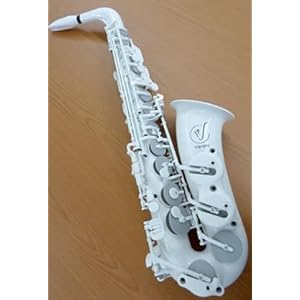
     Vibratosax is a company based in Thailand which has developed a completely polycarbonate alto saxophone. This subject is but another chapter on why I write this blog- people say some pretty one sided and opinionated stuff. Let me dish out the facts (and some of my opinions, of course) so that you can check it out and form your own thoughts. There's a lot of debate about this product, especially since the manufacturer is based in Thailand. I see nothing wrong with this. As long as the product is good- or at least super cool -it doesn't matter from where the product hails. This functioning plastic saxophone is super cool (in fact, I'm inclined to throw a duper somewhere in there) and demands some attention.
     The pads and keys are all made of interchangeable parts. This means that if some of your pads go bad, it's incredibly easy to replace them yourself. The alto is light weight and durable- after all, it is made of plastic.
A1S Colored Pads
     There are two main models as of this moment: the A1 and the A1S (the S stands for 'solid'). The A1, priced at $575, is pretty cool. The white and grey colors are modern and sleek. It's goofy, yet elegant: something that I wouldn't think twice about gigging with. The A1S features slightly more dense materials, offering a warmer, more 'vintage' sound, and goes for a hundred dollars more than it's counterpart. I've heard the clips that the company offers, and (keeping in mind that they were filmed with phones or bad cameras in general) the altos sound pretty darn good- and pretty vintage as well. The web pages (listed below) talk about a new Series II, that takes care of some lower register intonation issues. This is good, and something to look into. Also, the pages show the A1S Limited Edition: the same old A1S, but completely transparent. They're only selling a hundred, and each will have a serial number (001/100 to 100/100). It looks pretty cool, though I imagine you would have to clean it pretty well. The pages have no real information on how to buy one, or how much it costs, though I imagine that following the contact information would lead to that data.
     There's no way around it: for $500-$600 you can get a truly unique alto saxophone that sounds good; that comes with interchangeable and multi-colored pads and an option for a trippy looking gig bag for $60. There are a lot of people saying "It isn't from the U.S, and it should cost $200 based on the materials", but to that I say this: there was a lot of research and money to go into this product, which turned out to be a really fun looking and sounding saxophone. Also, if the U.S made this, it would cost easily thrice what it does now. Regardless, it's a pretty cool product. If you have the money and are looking for something to amaze people with, or just something new to play, get Vibratosax's A1 or A1S, I know I will.