Monday, August 6, 2012

Let's......Potato?

Things Happen

     Music is in no way strictly black and white. Things will happen to surprise you. In fact, this is perhaps the only certain thing about music. I've seen a fellow in the marching band I used to play with drop his saxophone and crush it, and later I was hardly able to play out of shock (and sadness for a fallen saxophone). I've cut myself to the point of bleeding on my saxophone, needing to play through the shock. This, as a young person, is not a fun thing to do- even if you can brag about it later. Sneezing, coughing or laughing into an instrument can easily throw you off with the squeals to follow, and a band in the entirety not playing, all but you, as the conductor waves on measure one can cause some flustered feelings. My point here is simply that shocking things do indeed happen, and you can never fully be ready for them. This said, you should be sure to discipline yourself enough so that when the unexpected happens, you can play on. In practice, the previously stated silly mishaps are whimsical and passing with little consequence. On the stage however, every single micro-event that occurs does so under a magnifying glass- a microscope between you and the eye of the crowd bellow. This is, at least, how you should feel as you sit- or stand -on stage. Babies will cry, cell phones will go off, and people will sneeze way louder than they should, but the show, as they say, must go on. A band that can play unwavering through a separate spectacle is a great band indeed and commands the respect of the audience: if the band ignores it, they'll ignore it.

Check Your Bell

     It is extremely likely that most if not all young saxophonists (or other wind and brass players with large enough bells) will continue putting things in their instruments out of habit. The bell of a saxophone is a tempting place to store all sorts of things. In mine, at a much younger age, I- for whatever reason -found a potato in my saxophone which continued to flatten all of my low notes. To spare the embarrassment of going through a practice with a potato in your lap, I encourage all players to check your bell just in case. However, in a more reasonable example of why you should check the airway of your instrument, I played through an entire concert containing a defining solo for me with a bottle's cork in the bell of my alto saxophone. I found that, during my playing, I had to tighten my embouchure more than I usually need to. I played well, but I also played far too hard than I should have, finding out exactly why only after I was putting my saxophone away. The music I was playing was of a classical genre- meaning that my playing and embouchure had to be extremely focused, as in the genre, pitch must be perfect (the reason I usually maintain that, in ways, classical is more challenging- at least physically -than jazz, given exceptions of course). You may be surprised at just how much your pitch can be affected by objects in your bell. In fact, try placing different objects (NONE that will become stuck, or break the horn!) inside the bell and play, listening to the difference, particularly in the lower register. Doing this may just let you know when something's wrong in the future and let you know what to listen for, but in practice and before concerts, be sure to check your bell for potatoes.


Friday, August 3, 2012

Let's Get to the Head of the Issue

Mouthpieces Matter

     At the head of any good saxophone sits, snuggly on the neck, a mouthpiece. Mouthpieces may be made of some strange materials, such as bone, glass, crystal or wood, but are usually made of one of three materials: plastic, vulcanized rubber or metal (usually bronze or stainless steel). The most common of the three materials is plastic, as most saxophones come with at least a plastic mouthpiece. Plastic is a good material. It's inexpensive and efficient- it gets the job done. Although, some are of much better quality than others. My first alto saxophone actually had a misshaped plastic mouthpiece, which I didn't find out until I was good enough to notice that the sound was far less than desirable at my level. They often times crack, not in any noticeable way. Tiny cracks on the bevel are common with some lesser quality mouthpieces. It is through this, and many other experiences that I recommend the same thing to everybody: when you purchase a new saxophone, always buy a new mouthpiece for it. For some reason beyond the common realm of logic, new saxophones, both top quality and not-so-top quality, always come with terrible mouthpieces. They suffice for younger students, as they produce the appropriate vibrations necessary for playing saxophone, but generally, I urge any owner of a new saxophone to get a complementary mouthpiece.
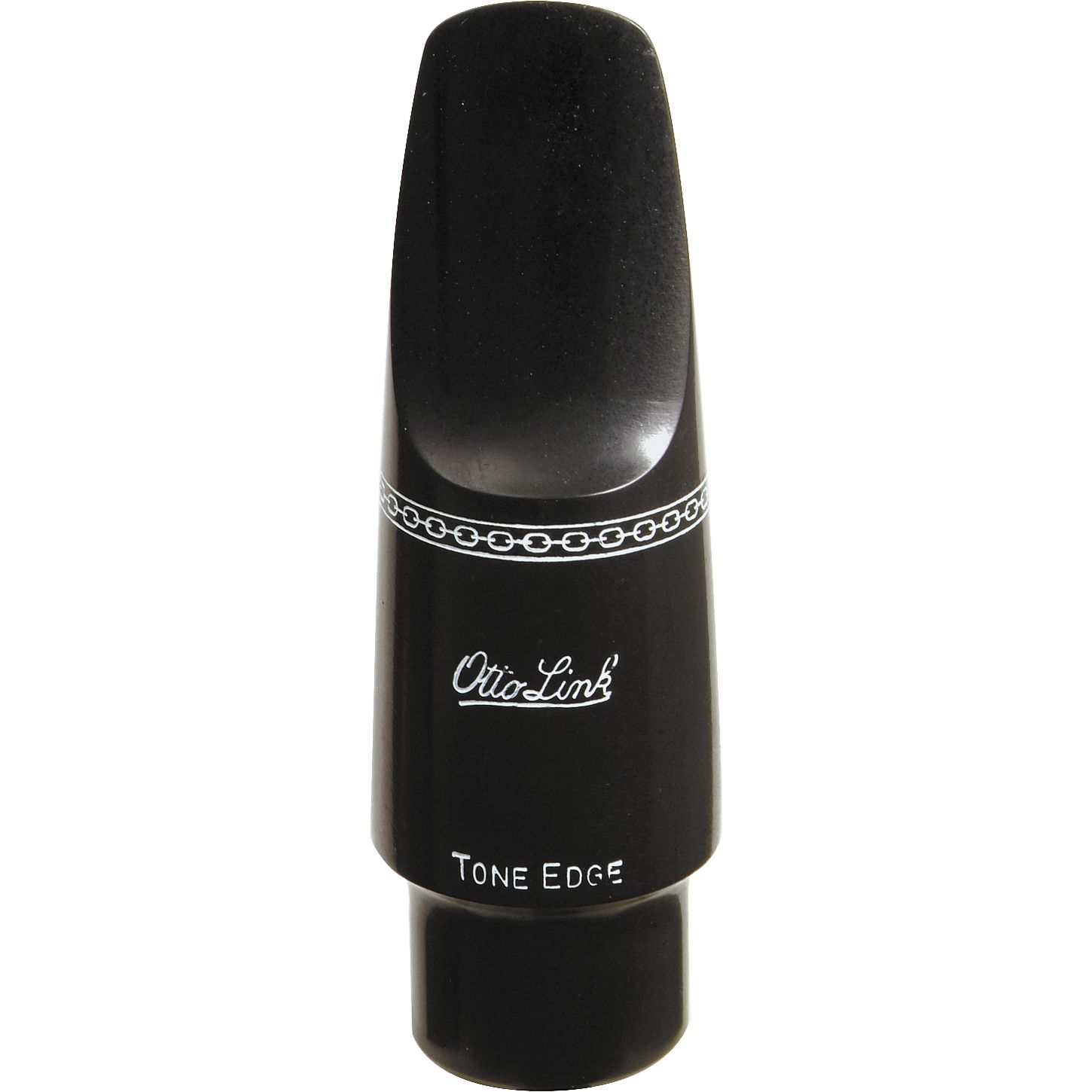
Otto Link Hard Rubber for Alto Sax
      Ultimately, there are good plastic mouthpieces in the world. I've seen some pretty nifty ones- you need only look. However, what I own for my alto saxophone and just love to bits is an Otto Link hard rubber, or vulcanized rubber, mouthpiece with a six facing and a tonal ridge, or tone edge. Hard rubber generally offers a warmer, or darker setting to your tone, as it has for me. It's superb for warm and gentle classical solos in a concert band situation. I opted for the tonal ridge, literally a ridge inside the mouthpiece that amplifies the sound a bit, so that I could achieve both warm and gentle, as well as loud and bright depending on the piece or my situation. With the six facing - facing being the gap between the tip of the mouthpiece and the reed (dependent, of course, on the angle of the 'facing') - I get more control over a wider range: I can play lows, either buzzy or not, and can maneuver through altissimo. In the end, I can play classical arrangements with the hard rubber, and jazz with the tonal ridge and the six facing. Hard rubber pieces come in many shapes and sizes. Not all have facings of six and tonal ridges. A purely classical hard rubber mouthpiece might have a three facing and smooth bevel. When it comes to the facing of a mouthpiece, it's purely up to the user, though I widely recommend either a six or seven facing, for alto saxophone especially.
     All of this applies as well to metal mouthpieces, something I've always been a bit infatuated with. While guitars have amps to drive up their loudness, saxophones have the equivalent metal mouthpieces. My curved soprano saxophone currently has one. It's a sturdy little sax, and with the added metal mouthpiece, it shreds through anything else in the way- truly a spectacular soloing instrument for a big band. Metal is notoriously bright, and many don't agree with using it. It takes a lot of control not to over blow while using one, and it has the potential to simply be too much. However, when it comes to a competent solo jazz player, a metal mouthpiece can really bring out the saxophone's signature sound quality- no matter which type you play. Unfortunately, metal can be expensive to have as a mouthpiece. A solid price for such a piece, given that the craftsmanship and overall quality is good, is just over a hundred US dollars. If you don't care about quality, for whatever reason (second instrument, practice instrument and so on), you can find them, depending on the sax type, for much cheaper. If you have the money though, you should go for a nicer quality mouthpiece- just don't hit your teeth on it.
Rovner Dark for Alto Sax
     Depending on the sound you're aiming to get, mouthpieces can make all the difference, though a good ligature to match is just as important. There isn't a whole lot to say about ligatures physically, but a good amount of research is very important, as different mouthpiece types may take different ligatures. Skinnier metal pieces take special ligatures, although all of them are the same in how they work. Basically, the less amount of material pushing on the reed, the better. This allows your embouchure to do all the work and, depending on the ligature, offers an even darker or lighter quality. The ligature that commonly comes with a saxophone's mouthpiece should go where that original mouthpiece does: not your saxophone! Leave the pair aside as a backup, then buy a new mouthpiece and a ligature- do not just use the ligature that comes with the new mouthpiece. The thin dual-screw metal ligatures break easily and offer no musical depth whatsoever. There are very inexpensive alternatives you can invest in. I have a Rovner Dark ligature, for instance, and you may notice that it looks quite different. It's a nice ligature and makes a big difference. There are also ring ligatures or band ligatures, mesh, or other alternative ligature types. Options abound, so don't ever settle for less. Mouthpieces do matter!


Wednesday, August 1, 2012

Let's Talk Bamboo

Cut for You

     Guitars have strings which need replacing. It's kind of a big deal, and a bit of a pain. I know many guitar players, and I know that string replacement isn't exactly fun for everyone. For saxophones there are no strings, but what does need the most replacing is the reed of the instrument. I recommend to the average young student to get cheap-cut reeds, usually the standard Rico reed will do because their inexpensive; a starting instrumentalist shouldn't waste money on good quality reeds. However, more advanced players have a few more options to sift through while buying reeds. There are different cuts which are simply the thickness of the reeds, which allow for buzzier lows or clearer highs depending on the cut. Usually, these cuts are measured in numbers in a very simple way. The thinnest I have ever seen for the saxophone in person is a 1.5 cut. The thickest I have seen is a 5. To put this in perspective, the most widely accepted and universal cut for a saxophone reed is 2.5- a cut that I use on both alto sax and soprano sax. It's perfect for most people because it allows for steady playing with modest embouchure work over the entire range of playing: from down at the Bb range through the upper altissimo area. Ultimately, choose what works best: the cut for you.

Don't Get Fooled

     Buying a brand of reed isn't as simple as you might think. Going off of peer recommendations is a sound idea, however do be sure to go off of multiple recommendations. Music is like politics: there are millions of opinions, and none of them are right- nor wrong. You must ask everyone you can and assimilate as much data as possible in order to form your own conclusion, because what works for others may not work for you. Eventually you'll find out things that aren't written in comments or ratings about a product. For example: I found myself quite loving the Vandoran V16's as recommended by my idol- a professional alto player with whom I play often. They're great, and there's no way around that. However, I eventually tried the Vandoran V12's, which are designed more for a smooth concert sound (thus my reason for purchasing them). Now, what these reeds did to surprise me was this: they played jazz - particularly in the altissimo range - better than the jazzy V16's. Did I strike gold here? Well in short- no. They did play better, but they cost the same as the V16's, with the downside being that they broke much easier if used this 'unintended' way. A reed like that is too expensive and, honestly, too nice to be shredding on the upper registers. Therefore I recommend getting two kinds of reed. One should be a solid reed for practice only, and the other a great reed that works for you in your gigs and performances. Does this cost a lot? Of course. But they end up lasting at least twice as long.
     Finally, when looking online or in a store for reeds, do your research before hand. A lot of sites (including the ones I love) list something like this:
Listed Price: $40.98
Our Price: $23.98
You Save: $17.00!
     After learning the market, you'll know that this is a bit of a silly lie to make their price seem spectacular. It's not a horrible crime as, like I said before, many of the sites I love to shop on do this. Just don't get tricked by something that looks great. Keep in mind that a good price for great reeds is in the lower twenty dollar range for a box of ten (just about two bucks a reed [in the US]). Whatever you do, don't get fooled.